Open-Plan Living-Dining Spaces: Zoning with Different Laminate Textures
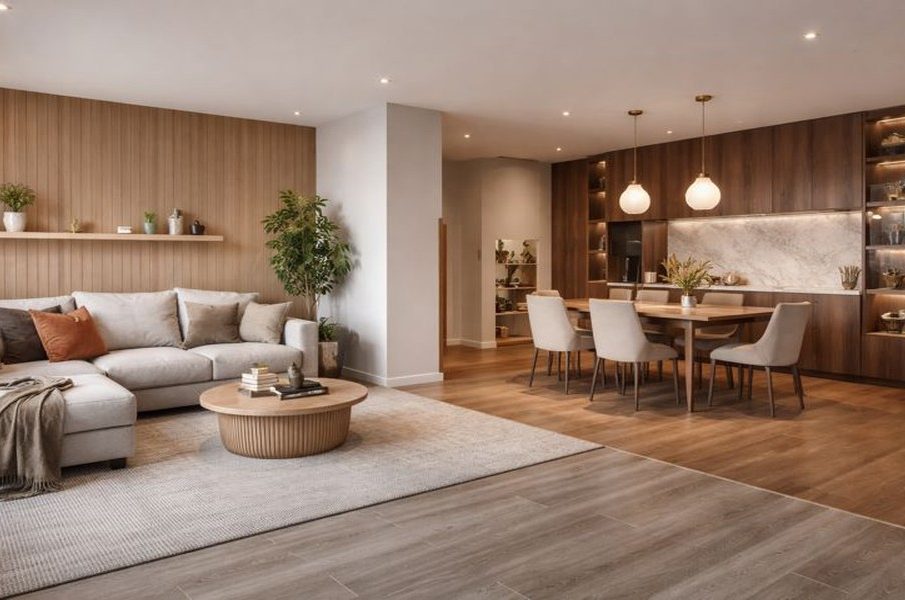
Open-plan layouts allow you to create spaciousness with light streaming in from both the living and dining areas. However, without zoning, an open-plan layout can become chaotic with no clear boundaries. Laminates can help create clearly defined “zones” in an open-plan layout by providing different surfaces (textures) for each area.
Zoning displays the various functions of each area and can assist you in creating an effective, cohesive interior design while maintaining the open feel of an open-plan layout. There are four benefits to zoning with laminates:
- Visual separation without blocking light
- Allows for independent function of each area
- Provides depth and texture to the overall interior design
- Creates continuity in design within the open-plan layout
Different Laminates on Dining Walls vs. Living Areas
Using laminate finish types, such as wood or textured finishes on the dining wall and smooth matte laminates in the living area, provides for visual separation of zones. This is an especially effective technique in a contemporary dining room design.
Laminate Finishes on Flooring
By having different laminate finishes on the flooring, you can provide visual separation between the living and dining areas while maintaining a seamless interior. For example, a warm, wooden flooring finish in the dining area works well paired with a neutral (stone) finish laminate in the living area.
Continuity from the Laminate Panels to the Ceiling
Using laminate finishes on all vertical surfaces in the space, including the ceiling, reinforces zoning. This also provides visual interest in the dining area and supports the overall restaurant planning & design.
Dining Furniture Finishes
Zoning will be more successful when laminate finishes are coordinated with the furniture selections. For instance, you might want laminate finishes that match the wood tones of the dining table design or contrasting gloss finishes with the dining chairs.
Best Practices when Zoning with Laminates
- Use darker or wood-textured laminates in the dining zone for grounding.
- Use lighter/softer laminates in the living area to maintain an airy feeling.
- Choose laminate finishes in the same colour family to avoid visual clutter.
- Use dedicated lighting over the dining table to enhance the overall restaurant design.
High-quality laminate collections, such as Royale Touche, offer a variety of options for mixing laminate textures while providing consistency in finish and durability throughout.
Summary
Utilising different laminates to define clearly identifiable “zones” in an open plan Living-dining area is an effective way of defining areas yet maintaining the perception of an open space. When selected tastefully, laminate will enhance both dining room design and dining table design while creating a consistent, modern approach to a functional, contemporary interior.