Kansas City Pest Control: Smokybrown and American Cockroaches, and the Species That Actually Come From Outside
A homeowner in Fairway watches a large reddish-brown cockroach run across the basement floor in August and assumes the house now has a German cockroach problem. A homeowner in a Brookside house with a brick patio notices a similar but darker cockroach near the garage door after a heavy summer rain. A homeowner in an older Kansas City bungalow finds a very dark, slow-moving cockroach in the basement sink in early June. All three are cockroaches, but none are the species that consumer content and generic pest control blogs have in mind when they recommend gel bait in kitchen cabinets. Kansas City pest control providers that handle cockroach calls across species, including ZipZap Termite & Pest Control in Lawson, see the same misidentification constantly. The larger cockroaches homeowners occasionally encounter in basements, garages, and on patios are different species with different origins and require different treatment than the German cockroach kitchen infestations covered in most online content.
The Three Outdoor-Origin Species in Kansas City
Three species account for nearly all non-German cockroach encounters across the metro. Each has a distinct appearance, habitat, and indoor-entry pattern.
The American cockroach (Periplaneta americana) is the largest of the three and often the most alarming to encounter. Adults reach 1.5 to 2 inches, are reddish-brown with a pale yellow margin around the pronotum (the shield-like area behind the head), and fly capably, particularly on warm evenings. Despite the name, the species is not native to North America. Populations live outdoors in sewer systems, storm drains, mulched landscape beds, hollow trees, and similar moist, warm locations. Indoor appearances typically involve single specimens that entered through floor drains, utility penetrations, garage door gaps, or the transition between exterior and interior spaces.
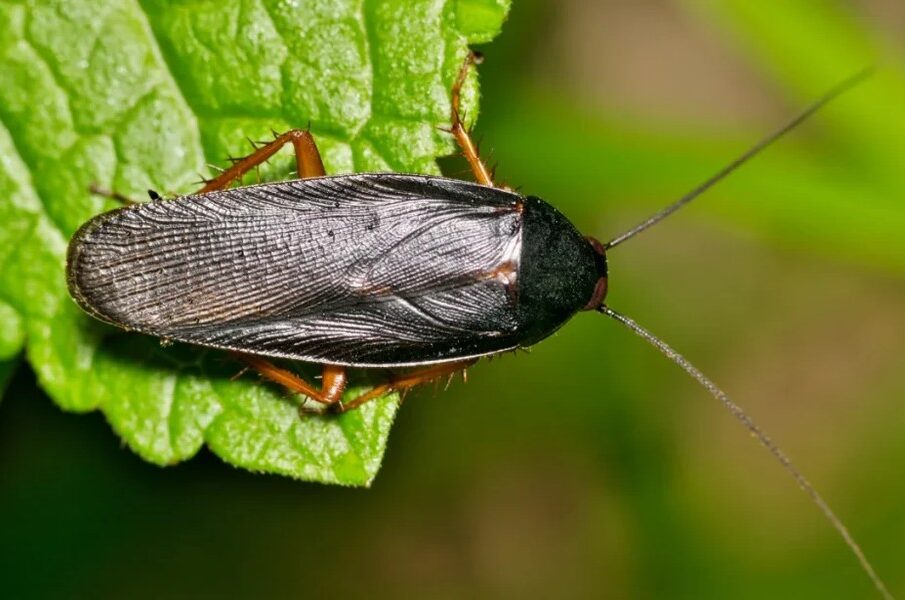
The smokybrown cockroach (Periplaneta fuliginosa) is slightly smaller than the American, typically 1.25 to 1.5 inches, and distinctively darker. Adults are uniformly shiny mahogany to nearly black, with no pale margin on the pronotum. The species is more common in the southern half of Missouri and historically was less established in Kansas City, though warming climate trends have expanded its range, and sightings across the metro are now consistent through summer months. Smokybrown cockroaches are strong fliers and frequently enter homes through second-story windows, soffit gaps, and roof-line transitions rather than at ground level.
The oriental cockroach (Blatta orientalis) is the smallest of the three, typically 1 to 1.25 inches, and the darkest. Adults are glossy black to very dark brown and substantially stockier in profile than the other species. Unlike American and smokybrown cockroaches, oriental cockroaches are poor fliers and rely on ground-level entry. The species strongly prefers cool, damp, dark environments. Basements, crawl spaces, cellar stairs, and the undersides of older brick patios are typical Missouri habitat.
Why None of These Are the “Apartment Infestation” Pattern
The German cockroach (Blattella germanica) is the species responsible for nearly all multi-unit residential cockroach infestations. It is an indoor-breeding species, completes its entire life cycle inside a warm structure, and spreads between apartments through shared walls and plumbing voids. The earlier German cockroach piece in this cluster covered those dynamics.
The three outdoor-origin species behave differently. They breed outdoors, enter structures opportunistically, and rarely sustain indoor reproduction. A homeowner seeing American, smokybrown, or oriental cockroaches inside is looking at an individual or a small group that crossed the building envelope from an exterior source, not an established indoor population.
The practical result is that German cockroach treatment approaches (gel bait in kitchen harborage, interior residual, bait rotation) do not address the actual problem. These species require exterior-focused work.
Why the Seasonal Pattern Matters
American and smokybrown cockroach indoor appearances spike dramatically during specific weather conditions across the Kansas City summer.
Heavy rain events push populations out of their preferred outdoor habitats (storm drains, mulched areas, landscape voids) and produce clusters of indoor sightings over the following 24 to 72 hours. A homeowner who finds a large cockroach inside two days after a summer thunderstorm is usually seeing weather-driven displacement rather than a new indoor population.
Late-summer heat stress produces a second wave. When outdoor temperatures sustain above 95°F and the typical moist microhabitats dry out, cockroaches move toward any accessible cool, humid alternative. Basements, crawl spaces, and garage interiors all fit the profile.
Fall transition produces a third smaller wave as cockroaches seek overwintering shelter before temperatures drop. Oriental cockroaches in particular establish in basement locations during this period and occasionally persist through winter in heated structures.
These patterns matter for treatment timing. A treatment program aimed at outdoor-origin cockroaches achieves better results when applications are scheduled before rather than after the expected weather-driven influx.
What Actually Controls Outdoor-Origin Cockroaches
Treatment for these species inverts the indoor-focused approach that works against German cockroaches.
Exterior perimeter residual application to the building foundation, garage doors, utility penetrations, expansion joints, and the transition zones where cockroaches most commonly enter forms the core of the program. Products containing bifenthrin, deltamethrin, or similar residual pyrethroids provide several weeks of barrier coverage.
Harborage reduction around the foundation matters significantly. Mulch piled against siding, accumulated leaf litter in basement window wells, stacked firewood near the house, and dense vegetation touching the foundation all provide the damp, protected microhabitat these species prefer. Clearing a clean zone around the foundation perimeter reduces the population actively pressing on the building envelope.
Structural exclusion addresses the specific entry points. Weatherstripping replacement on garage doors, screen repair on basement windows, sealing of utility penetrations, and trap primer maintenance on floor drains all reduce entry opportunities.
Interior treatment is usually limited in scope. A residual application along basement baseboards, in utility rooms, and around floor drains handles the occasional specimen that enters despite exterior and structural work, but broad interior spraying of the type sometimes used for German cockroach control is unnecessary for outdoor-origin species.
Drain maintenance matters for oriental cockroaches specifically. Seldom-used floor drains that have allowed the P-trap to dry out become direct entry points. Monthly water pouring into rarely used floor drains maintains the water seal that blocks entry.
When Kansas City Pest Control Involvement Makes Sense
Occasional outdoor-origin cockroach sightings in a home with a clean perimeter usually resolve with basic structural and exterior maintenance. Several situations warrant professional treatment.
Properties with repeat indoor sightings across multiple rooms and multiple weeks indicate a sustained outdoor population pressing on the building envelope, which benefits from exterior perimeter treatment and harborage assessment.
Homes with older brick patios, extensive landscape mulch, or proximity to storm drains and sewer access points experience higher cockroach pressure than typical residential lots and often require seasonal perimeter programs rather than reactive single treatments.
Any cockroach sighting that the homeowner cannot confidently identify warrants a professional assessment, because the German-versus-outdoor-origin distinction matters significantly for treatment choice.
A Kansas City pest control provider with species-specific experience, such as ZipZap Termite & Pest Control, can identify the cockroach, locate the entry points, and build the exterior-focused program that actually addresses outdoor-origin species.
The Short Version
American, smokybrown, and oriental cockroaches are outdoor-origin species that occasionally enter Kansas City homes through specific weather and structural vulnerabilities, and they require exterior perimeter treatment rather than the interior gel bait approach that works for German cockroach kitchen infestations. Seasonal timing, harborage reduction, and structural exclusion address the actual pattern. For homeowners encountering large cockroaches during summer rain events or in basement spaces, a Kansas City pest control provider such as ZipZap Termite & Pest Control can identify the species and treat the exterior conditions that produced the sighting.